
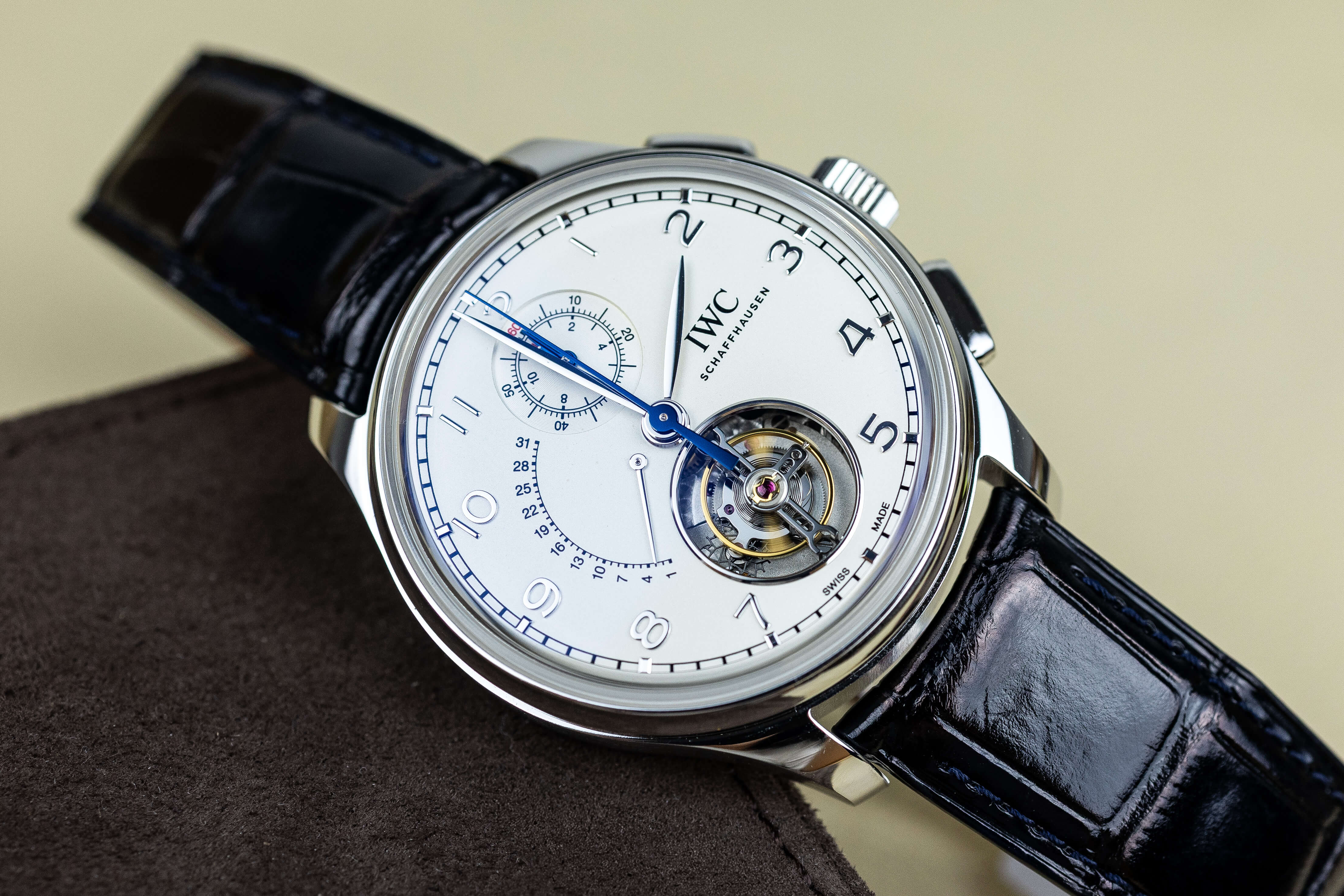
Some watches stand out because of their appearance. Others, on the other hand, draw attention because of what’s happening beneath the Dial . The IWC Portugieser Tourbillon Rétrograde Chronograph IW3494006 does both. A Case made of solid 950 platinum, a subtle silver-colored Dial , and beneath it a Movement that brings together three impressive complications.
It's a watch that lets you do more than just tell the time. You get to see the technology that makes time visible.
Three complications in one Portugieser
The Portugieser Tourbillon Rétrograde Chronograph combines three exceptional functions: a flying minute tourbillon, a retrograde date display, and a flyback chronograph.
The flying tourbillon is located at 6 o'clock. On the opposite side of the Dial, at 9 o'clock, the date runs from 1 to 31 along a curved scale. At the top, at 12 o'clock, is the chronograph's combined hour and minute counter.
It is precisely this layout that makes the watch interesting. Each complication has its own place, but together they form a single whole.
The platinum version we’re looking at here is also exceptionally rare. Only 50 pieces of the IW3494006 were produced. The 950 platinum Case is paired with a silver-colored Dial and rhodium-plated hands, giving the watch an understated look. Despite its technical sophistication, the watch doesn’t look overly busy as a result.
The tourbillon: a mechanism that keeps moving
Of the three complications, the tourbillon is perhaps the one that most captures the imagination.
A tourbillon was originally designed to counteract the effects of gravity on the regulating mechanism of a mechanical watch. To achieve this, the escapement is housed in a rotating cage. Because this cage is constantly changing position, it counteracts any deviations that might be caused by gravity.
Nowadays, a tourbillon is no longer essential for a modern wristwatch, as it once was for pocket watches. Yet this complication remains one of the most admired features in haute horlogerie—not only because of the idea behind it, but above all because of the complexity involved in constructing such a small mechanism.
In this IWC, that effect is made even more impressive by the flying tourbillon design. The cage has no lower bridge, making the mechanism appear to float freely within the opening.
As a result, something happens every minute at six o'clock. It's a small mechanical theater that never stands still.
56 parts at six o'clock
The Portugieser's flying minute tourbillon consists of 56 individual components and weighs a total of just 0.675 grams.
That perhaps best illustrates the technical challenge. While a tourbillon may, at first glance, appear to consist of a small rotating component, behind that appearance lies an extremely complex mechanism.
IWC has also incorporated an integrated tourbillon stop. This allows the tourbillon to be brought to a complete stop, so that the time can be set with precision down to the second.
The materials used in the “ Movement ” also incorporate a great deal of technology. The anchor wheel and escape wheel are made of silicon and feature IWC’s Diamond Shell technology. This treatment reduces friction and improves the flow of energy through the “ Movement.”
The result is a power reserve of 68 hours.
A date that jumps back
While the tourbillon is constantly in motion, the date display has a completely different character.
At nine o'clock, a small hand moves along an arc-shaped scale numbered from 1 to 31. When it reaches the end of the month, the hand jumps back to the beginning of the scale.
That is exactly what makes a retrograde display so recognizable. Instead of a date window where one digit appears after another, the hand makes a visible movement across the Dial and then returns to its starting position.
It's a relatively simple way to display the date, but from a mechanical standpoint, it gives the Dial a completely different character.
The Flyback Chronograph
There is a third complication to consider: the flyback chronograph.
The chronograph displays the elapsed hours, minutes, and seconds. The hour and minute counters are combined in a totalizer at the 12 o'clock position.
What makes it special is the flyback function. With a traditional chronograph, you first have to stop it, then reset it, and then start it again. With the flyback function, you can do all of that in a single motion. While the chronograph is running, the hands are immediately reset to zero and the time measurement starts over.
For a watch enthusiast, it is precisely this kind of mechanical interaction that is fascinating. You press a button and see not only a function change, but an entire mechanism respond.
Caliber 89900
All of these functions are powered by the IWC-manufactured Caliber 89900.
The automatic Movement consists of 375 individual parts and operates at a frequency of 28,800 beats per hour, or 4 Hz. The Movement features 42 jewels and has a power reserve of 68 hours.
The mechanical heart remains visible through the sapphire crystal case back. There, you can also admire the finish of the " Movement ," which features Geneva stripes and circular decoration, among other details.
One striking detail is the solid 18-karat gold winding rotor. This gives even the back of the watch its own distinctive visual element.
950 platinum as a silent base
Technology may take center stage, but the Case plays a major role in determining how the watch feels.
This IW3494006 model is crafted from solid 950 platinum. This gives the Portugieser a look that differs from the gold version shown in the official IWC documentation.
The silver-colored Dial and rhodium-plated hands complement this beautifully. As a result, the overall look remains understated, even though there is a tremendous amount of technology beneath the surface.
I think that contrast is perhaps one of the most appealing features of this watch. From a distance, you see an elegant Portugieser. It’s only when you take a closer look that you discover everything that’s going on.
A rare Portuguese
The IWC Portugieser Tourbillon Rétrograde Chronograph IW3494006 is limited to just 50 pieces.
This means it’s not just any old Portugieser with a complicated Movement. It’s a watch that brings together some of the most fascinating mechanical complications: a flying minute tourbillon, a retrograde date, and a flyback chronograph.
And maybe that's exactly why this watch is so interesting, after all.
The tourbillon completes a full rotation every minute. The date slowly advances toward the end of the month and then jumps back. The chronograph can restart its timing at any moment. Meanwhile, the Caliber 89900 continues to operate, hidden behind a sapphire crystal case back.
The IW3494006 thus showcases what makes mechanical watches so appealing to many enthusiasts: time is not only displayed here, but also revealed as a work of engineering.